Insights
The Diesel & Material Spike: Why Fixed-Price Bids Are Failing GCs This Summer
The way contractors handle risk in 2026 will decide who keeps winning work and who starts losing margin quietly in the background. If you are running a commercial general contracting firm right now, you already know the sinking feeling of watching a project that looked beautiful on paper in January turn into a knife fight for profitability by July.
The reality of the current construction environment is hitting margins from angles that traditional contingency lines simply weren't built to handle. Between surging fuel costs driving up material indexes and interest rate relief officially sidelined for the foreseeable future, the buffer room for errors has entirely vanished.
If your team is still relying on weekly meetings or bi-weekly reports to spot field issues, you aren't just managing retroactively, you are actively absorbing market volatility that could be prevented.
The Perfect Storm: The Macro Reality Facing Jobsites Right Now
For the past several quarters, the executive narrative in construction was focused on waiting out the storm. There was a collective hope that supply chains would fully stabilize and financing pressures would ease. Instead, summer has brought a harsh macro-economic reality check:
The Energy Premium: Diesel prices and transportation surcharges have quietly crept up, spiking supply chain operational costs across the board. Every single yard of concrete, load of structural steel, and delivery of drywall carries an inflated logistics premium that hits your bottom line before the material is even unhitched from the flatbed.
The "Higher for Longer" Financing Trap: Because the Federal Reserve has kept borrowing costs elevated, working capital is more expensive than it has been in a generation. Carrying a project even a few weeks past its scheduled completion date is ballooning your overhead and saps your bonding capacity for the next proposal.
The Fixed-Bid Exposure: Entering into a lump-sum or fixed-price contract used to be a standard baseline for predictable revenue. In the current economic climate, a fixed bid is a ticking clock. If your input costs morph in the background while your contract price remains locked, you are the one holding the bag.
The Subcontractor Risk Multiplier
When a general contractor's margins get squeezed by the macroeconomy, remember that your subcontractors are feeling the exact same pressure—often on a much tighter cash-flow runway.
To protect their bottom lines, specialty subs are making quiet, tactical adjustments in the field that directly expose the GC to massive liability. They won't announce these changes at the job trailer; they happen subtly:
Under-Staffing Job Sites To save on labor burdens, a subcontractor might quietly pull two or three skilled guys off your project to prop up a different job elsewhere. Suddenly, a framing sequence or an electrical rough-in that should take four days stretches into nine.
Cutting Material Corners When material indexes spike, the temptation to substitute specified, high-grade components with cheaper, unapproved alternatives increases dramatically. If your team doesn't catch a material specification deviation during installation, you are looking at a brutal tear-out or a rejected inspection months down the road.
Scheduling Slippage Because specialized labor is tight and logistics are unpredictable, subs are failing to hit their critical path milestones. They miss a morning walkthrough or delay a layout validation by 48 hours, triggering a domino effect that stalls every trade coming in behind them.
The Weekly Report Delusion: Three Critical Blind Spots
Most executive teams believe they have a handle on this risk because they mandate rigorous reporting. They look at the weekly summaries, run the cost-to-complete metrics, and hold intensive project review meetings.
But relying on weekly rollups creates three recurring blind spots that quietly erode gross margin across active jobs:
1. The Delay Gap
If a subcontractor falls behind on a critical path item on a Monday morning, but it isn't formally reviewed or flagged to the executive level until the following week's coordinator meeting, that is five full days of unmitigated margin bleed. The mistake has already compounded.
2. The Raw Text Graveyard
Superintendents are incredible at running a safe, productive job site, but they are not technical writers. They record exactly what happens in their raw daily logs—notes like "Waiting on structural layout validation" or "Sub contract crew understaffed today." Because these notes are buried in hundreds of pages of unformatted text, they are rarely analyzed until a delay has already manifested into a scheduling crisis.
3. The Lack of Immediate Leverage
To successfully execute a back-charge, defend against an unfair subcontractor delay claim, or file an unassailable insurance recovery, you need an airtight, immediate paper trail. If you try to recreate the timeline retroactively weeks after the incident occurred, you lose your leverage. The sub's lawyers will poke holes in your documentation, and your cash remains trapped.
Moving from Reactive Management to Real-Time Margin Defense
The contractors who win in the current landscape are those who recognize that a daily price creep can only be defeated with daily field intelligence. You cannot afford to wait for the information to bubble up through traditional corporate layers.
This is exactly why we built CostAnchor.
Instead of forcing your field teams to adopt complicated new software, fill out endless digital forms, or undergo grueling IT retraining, CostAnchor works entirely in the background. Your superintendents continue writing their daily logs exactly how they always have. They simply carbon-copy (CC) our system's email inbox when they submit their report.
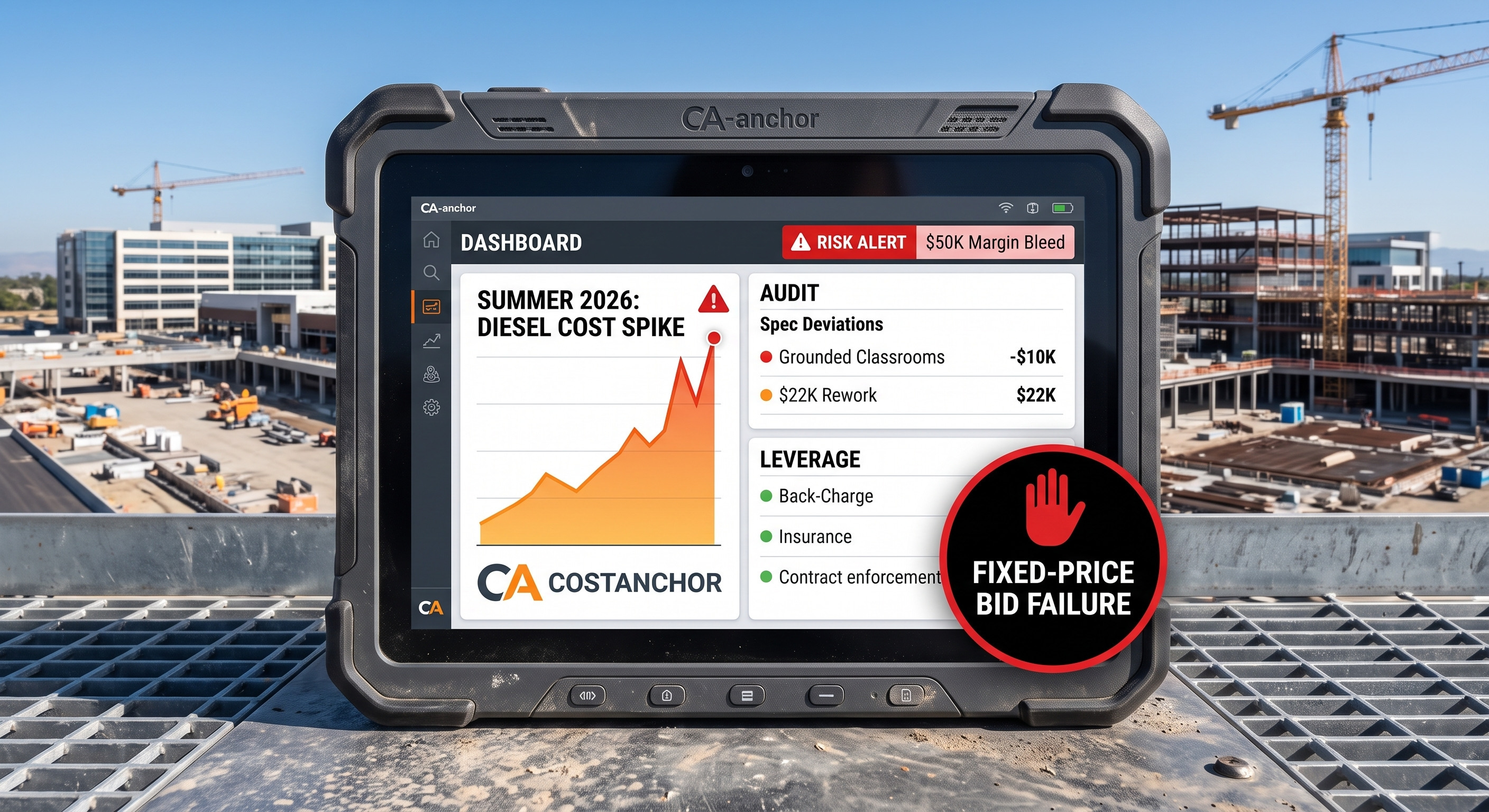
Our automated risk intelligence engine instantly reads the raw, unedited text of incoming dailies. It acts as a 24/7 autonomous auditor, scanning every line against your project's specific contract rules, schedule obligations, and material specifications.
If a sub skips an inspection, introduces a schedule risk, or triggers a material deviation, CostAnchor flags it the exact day it happens. It isolates the precise sentence from the field log, calculates the potential financial impact, and delivers an audit-ready paper trail straight to your dashboard.
You get complete executive visibility and the indisputable leverage you need to hold trades accountable, protect your timeline, and eliminate margin fade before it eats your profit.
Stop Letting Field Delays Dictate Your Profitability
In a high-velocity economic environment, waiting until Friday to find out what went wrong on Monday is an expensive way to run a business. Protect your active job sites with the real-time, zero-friction risk intelligence your team deserves.
See exactly how CostAnchor automatically audits your daily logs and builds an unassailable margin defense system for your portfolio.