Insights
Why 2026 is the year smart contractors start protecting margins earlier
If you are a general contractor in the U.S., you are not imagining the squeeze.
Input costs are higher. Schedules are tighter. Labor is harder to keep. And every project seems to start with a little more risk than it did a few years ago.
This is not a "doom-and-gloom" piece. It is a simple reality check: the way contractors handle risk in 2026 will decide who keeps winning work and who starts losing margin quietly in the background.
1. The new normal for input costs and schedules
In 2026, construction is still active, but it is not easy.
Big-ticket industrial, infrastructure, and data-center projects are moving forward, but many smaller or speculative jobs are getting narrower spreadsheets and tighter timing. At the same time, energy, fuel, and some key materials are more expensive, and supply-chain noise is louder.
For general contractors, that means two things:
- You cannot absorb mistakes the way you might have in the past.
- You have to be more careful about what you promise in the field and how you track it back at the office.
When every dollar matters, small issues that were once "annoyances" can become margin-killers.
2. The quiet margin-eaters no one talks about
Most contractors talk about bids, negotiations, and change-order approvals. Fewer talk about the quiet margin-eaters that live in their daily reports.
Several of the biggest hidden risks today include:
- Delays that never get logged. Weather, inspections, subcontractor hold-ups, and RFIs that are mentioned in the field but never make it into your formal tracking.
- Scope changes that stay in the air. Small changes agreed to in passing, never written down, and later turned into disputes or change-order delays.
- Reports that get read once and forgotten. Superintendents are sending daily updates, but the office is too busy to mine them for risks until the problem is already costing time and money.
In a world where margins are tight, one missed issue can wipe out most of the profit on a job, even if the original bid looked solid.
3. How top contractors are changing their habits
In 2026, the most profitable contractors are not just raising prices. They are tightening their habits.
Some of the moves that are working well:
- Focusing on fewer, higher-quality projects. Instead of chasing every lead, many teams are choosing to protect margins on fewer jobs done more cleanly.
- Getting serious about change control. Every small change, waiver, or schedule adjustment is being documented and tracked in one place, not handled in passing conversation.
- Adding lightweight tools that sit on top of existing workflows. Instead of forcing teams into big new software, contractors are using simple layers that review what they are already sending every day.
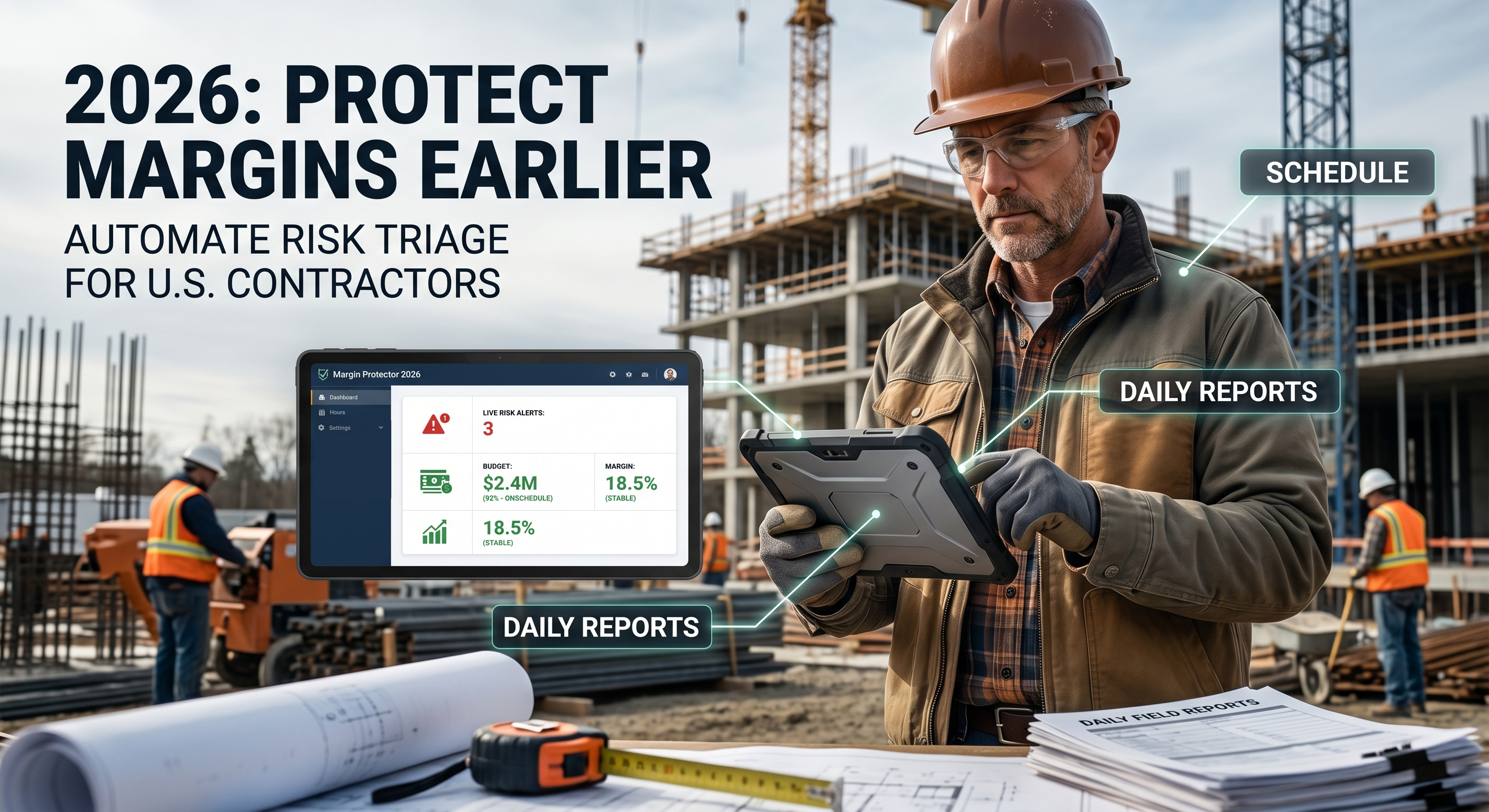
This is where the "risk-watch" idea becomes powerful. Instead of asking your team to track something new, you can ask them to keep doing what they already do and let a smart layer catch the signals they might miss.
That is especially true for GCs who work across multiple states or regions, where field communication is harder to control and more prone to drift.
4. Turning risk into a planned part of the workflow
Risk is not going away. But it does not have to be a surprise.
Practical steps you can start with your next project:
- Audit your last job for one-off issues that turned into extra cost: undocumented delays, scope gaps, miscommunication with subs.
- Clarify your change-control workflow so every small change, waiver, or schedule adjustment gets logged the same way every time.
- Add a tool that reviews your daily reports. If your team is already sending daily superintendent reports, consider a system that scans them against specs and schedules, then flags issues instead of making someone read every line manually.
In a tight market, catching risk earlier is the same as protecting margin. That is not a sales pitch. It is a simple arithmetic truth.
5. What this means for the rest of 2026
Construction is not going back to the way it was a few years ago.
You are not going to get back to "easy-margin" days by just bidding harder. You are going to protect your profit by:
- Understanding how current events are changing project risk.
- Focusing on fewer jobs done more cleanly.
- Using smart tools that fit your existing workflow, not fight it.
The winners in 2026 will not be the teams that chase every lead. They will be the teams that protect their margins, document their changes, and watch their field-to-office communication like it is the single most important file in the project folder.
If you need a simple way to catch project risk earlier, See How It Works in 7 Minutes and see how much margin you can protect on an active job.